
Reverse Osmosis vs. Carbon vs. Pitcher Filters: What Each One Actually Removes
Choose reverse osmosis, carbon filtration or a pitcher by the specific water concern and the outlets you want to treat. Carbon systems commonly address taste and odor; some have additional certified contaminant claims. Reverse osmosis can reduce particular dissolved substances at a drinking-water outlet. A pitcher describes a product format, not a universal treatment capability. Compare exact models, maintenance and installation before deciding.
Start with the question the filter needs to answer
Write one sentence describing the problem: “I want less chlorine taste in drinking water,” “I want to reduce a measured contaminant,” or “I want less scale throughout the house.” Those are different objectives. A recommendation that does not identify the objective is difficult to assess, even if it includes an impressive list of stages or standard numbers.
Review your provider’s report and any relevant household tests first. Our Miami-Dade report guide explains how to identify the correct system, units and sampling context. The CDC’s filter guidance recommends matching treatment to the concern and notes that taste, smell and appearance cannot reliably establish safety. Most household pitcher and refrigerator filters are not designed to remove germs.
Separate the filter format from the treatment technology
A pitcher treats water in batches using a replaceable cartridge. A faucet-mounted or under-sink carbon unit treats water as it passes through that device. Whole-home equipment treats the supply routed through it near the entry point. These formats differ in convenience, capacity and plumbing requirements, but their shape does not tell you every substance they can reduce.
Carbon works through adsorption and, depending on the cartridge design, physical filtration. An RO system uses pressure across a membrane and usually includes additional filter stages. That means “carbon versus RO” is not always a choice between mutually exclusive materials: an RO assembly can also contain carbon cartridges. Judge the certified performance of the complete system and approved components.
Stage counts are not a useful stand-alone ranking. Three well-documented stages can address a particular need more convincingly than an unexplained seven-stage claim. Ask what each stage does, when it is replaced and which claim belongs to the finished assembly. A decorative diagram is helpful only when it matches the equipment actually quoted.
When a carbon filter may fit
If your main concern is chlorine taste or odor at one drinking-water outlet, a product with that specific reduction claim is a reasonable category to compare. Some carbon systems also have certified claims for named health-related contaminants. Do not assume that all carbon cartridges share those claims, or that a larger housing automatically provides longer certified performance.
For a pitcher, consider how often you refill it, how much usable water it holds and whether the cartridge is readily available. For an under-sink unit, consider flow, service clearance and the faucet arrangement. For whole-home filtration, consider simultaneous demand from multiple fixtures. These everyday details determine whether the selected format actually fits your routine.
In Miami-Dade, distinguish chlorine from chloramine. A chlorine claim does not establish chloramine reduction. If chloramine is the target, request documentation that explicitly names it, with capacity, flow and test conditions. Describe manufacturer performance information accurately rather than presenting it as independent certification when it is not.
When reverse osmosis may fit
RO is worth comparing when your drinking-water goal involves substances covered by the exact system’s reduction claims. The treated outlet can supply water for drinking and food preparation, provided the installation and operating conditions match the instructions. The equipment still needs appropriate feed water, routine service and a plan for replacement cartridges and membrane care.
Under-sink RO does not solve every household water issue. It does not automatically soften shower water, protect every appliance from scale or treat an unconnected refrigerator line. A family choosing it for kitchen water should list the outlets they actually use, including ice and cooking water, and ask which connections are included in the proposal.
RO also produces a concentrate stream. EPA WaterSense reports that typical point-of-use systems can send five or more gallons to the drain per gallon treated, while WaterSense-labeled models must send no more than 2.3. These are program-level comparisons, not a measured ratio for every installed unit. Check the exact model’s documentation and expected operation at your home. Do not assume a system carries the label without verifying it.
Read certifications as specific claims
NSF explains that standard numbers are not performance rankings. NSF/ANSI 42 includes aesthetic claims, 53 covers particular health-related reductions, 58 addresses RO systems and 44 addresses softeners. Certification under one standard does not mean that a model reduces every substance associated with that standard.
Find the manufacturer, complete model designation and replacement cartridge in the certifier’s directory. Then read the listed substance, capacity and applicable conditions. Save the listing with your purchase records. Our certification page provides a starting point for the Hydrality products discussed below. If a claim is missing, ask for supporting documentation before relying on it.
How Hydrality’s two product families differ
The Puronics Hydronex iGen C combines whole-home filtration and salt-based softening. WQA’s NSF/ANSI 42 listing identifies Hydronex iGen 30C and 45C for chlorine taste and odor. Its NSF/ANSI 44 listing includes hardness, barium and radium 226/228. These claims should not be expanded into a promise to remove every chemical.
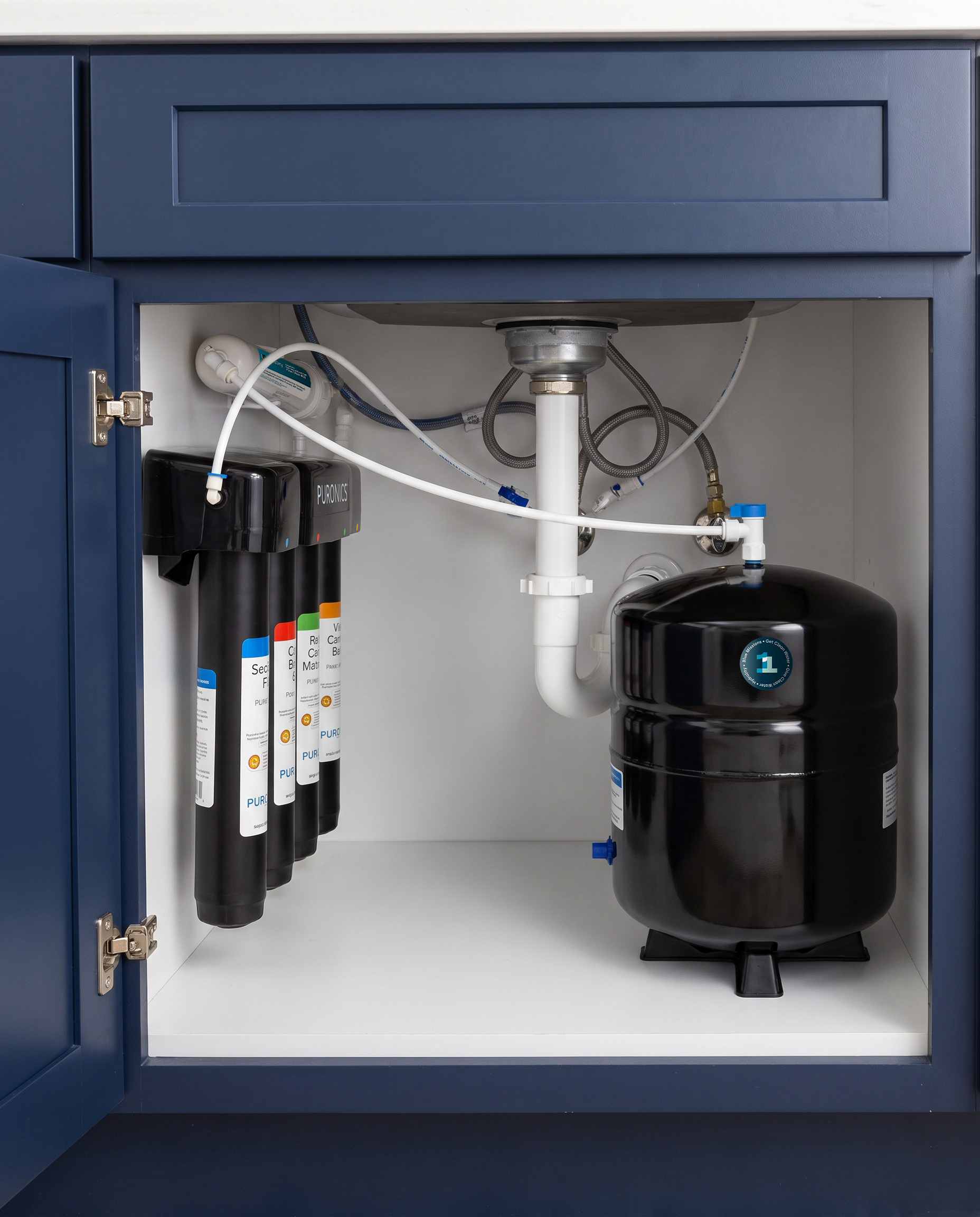
The Puronics Micromax 8500 is an under-sink drinking-water system. WQA lists chlorine taste and odor under 42, PFOA/PFOS and VOC reduction under 53, and specified RO claims under 58, including TDS, lead and fluoride. A PFOA/PFOS claim is not a claim covering every PFAS.
Both families also appear in the NSF/ANSI/CAN 372 listing for lead-content compliance. That concerns materials in the product; it does not independently establish lead reduction from water. Keep product-material requirements separate from treatment performance when comparing proposals.
Choose the treated outlets before sizing equipment
Walk through an ordinary day and note where water is used. Include drinking bottles, coffee, cooking, ice, showers and laundry. Put the outlets into two groups: those needing the specific drinking-water treatment you selected, and those involved in whole-home comfort or scale concerns. This prevents paying for a broad installation when a smaller one fits, or expecting a small unit to perform a whole-home job.
A renter may need a solution that avoids permanent alterations. A condo owner may need association approval and confirmation that an individual supply line can be accessed. A detached home may have a suitable entry location but limited drain access or service clearance. Have the installer confirm these conditions before treating a generic product recommendation as an installation plan.
For a combined approach, request a simple drawing showing where each system sits and which outlets remain untreated. Include bypass arrangements, shutoff locations and future service access. Our whole-home versus RO guide explains this planning distinction in more detail.
Compare ownership cost rather than purchase price alone
Request a written total that separates equipment, installation and optional connections. Then list replacement cartridges, membrane service, salt where applicable and any recurring service charge. Ask which items are included, which are additional and what happens if your usage changes. A low initial price is hard to evaluate without the expected service requirements.
For a fair comparison, use the same planning period and household usage assumptions for each option. A pitcher used occasionally and an under-sink system used throughout the day serve different workloads. Do not compare their advertised cartridge lifespans without checking rated gallons and the applicable time limit. Ask for current prices instead of relying on an old online estimate.
Also consider the work you are willing to do. Refilling a pitcher, changing cartridges or keeping a softener supplied with salt may be straightforward, but the routine must be realistic for your household. A clear service arrangement can be valuable when equipment is difficult to access or the home is occupied seasonally.
Maintain the exact system you purchased
NSF’s replacement guidance emphasizes following the manufacturer’s schedule and using the correct cartridge. A look-alike part that fits a housing is not automatically equivalent. Some reduction capacity can be exhausted without an obvious change in taste or flow, so sensory checks cannot replace scheduled maintenance.
Photograph the model label and keep the approved part numbers with your service record. Record installation dates, replacement dates and any unusual pressure or flow changes. Before a long absence, follow the manufacturer’s shutdown and restart instructions. Our RO filter schedule guide explains how to build that record and when to request a service assessment.
Three examples of a useful comparison
Consider a household that likes its shower water but dislikes the taste of water from the kitchen tap. Its first comparison might be between a certified pitcher cartridge and a dedicated carbon filter. The practical questions are refill frequency, available space, rated capacity and replacement availability. Adding a softener would introduce a different function that has not yet been identified as a need.
Now consider a household with recurring scale and a separate concern about lead at the drinking-water faucet. Those goals should be assessed independently. Hardness testing can inform a softening decision, while an appropriate lead sampling plan and a verified lead-reduction claim inform the kitchen-water decision. Combining two systems may be reasonable, but the proposal should explain why each is included rather than suggesting that one generic filter solves both concerns.
Finally, consider a seasonal condo with little cabinet space and an existing refrigerator filter. Before adding equipment, identify the refrigerator’s actual cartridge and claims, how often the home is occupied and who will handle service. Measure the usable space and confirm whether another faucet or drain connection is permitted. The best comparison may change once those constraints are known, even when the water-quality goal remains exactly the same. These are planning examples, not diagnoses or recommendations for an unidentified property.
Use a focused consultation to make the final decision
Bring your utility report, relevant test results, cabinet photos and a list of the outlets you want treated. Ask the installer to connect each recommendation to an identified goal and a documented claim. If the concern requires laboratory testing, settle the sampling question before interpreting a basic demonstration as a complete assessment.
You can discuss your home’s water with Hydrality and confirm the scope of the visit in advance. The useful outcome is a clear comparison: the problem addressed, the exact model, the installed configuration and the ongoing care. That gives you a stronger basis for choosing than a broad promise of “pure water” or a stage count.
Frequently asked questions
Is reverse osmosis always better than carbon filtration?
No. The better choice depends on the substances you want to reduce, the outlets you want treated and the exact product claims. A certified carbon filter can suit a taste-and-odor goal. RO may suit particular dissolved-contaminant goals, with additional installation, maintenance and water-use considerations.
Does a pitcher filter remove PFAS or lead?
Some pitcher and cartridge combinations have certified claims for particular substances, but many do not. Match the exact system and replacement cartridge to the directory listing. A chlorine taste-and-odor claim alone does not establish lead, PFOA or PFOS reduction.
Will a carbon filter soften hard water?
Carbon filtration alone does not provide ion-exchange softening. If the goal is reducing calcium and magnesium hardness throughout the home, compare an appropriately sized softener. A combined product may contain both filtration media and softening resin, so check the functions separately.
Can the Micromax 8500 treat every faucet?
The Micromax 8500 is an under-sink drinking-water system for its connected outlet. It does not automatically treat showers, laundry or every kitchen connection. Verify any proposed refrigerator or additional outlet connection with the installer and manufacturer’s requirements.
Does chlorine certification also cover chloramine?
No. Chlorine and chloramine are separate reduction claims. Ask for a specific chloramine certification or clearly identified performance documentation for the proposed model, including capacity and operating conditions. Do not infer that claim from NSF/ANSI 42 alone.
How do I know when replacement cartridges are due?
Follow the exact system’s time and gallon limits, replacement part numbers and service instructions. A calendar reminder and service record help. Changed taste or reduced flow may prompt a service check, but normal taste and flow do not prove that every certified reduction remains effective.
By Hydrality
Last reviewed: November 17, 2026.
Sources: US EPA: PFAS in drinking water · US EPA: Lead in drinking water · Hydrality: NSF/ANSI certifications for the systems we install